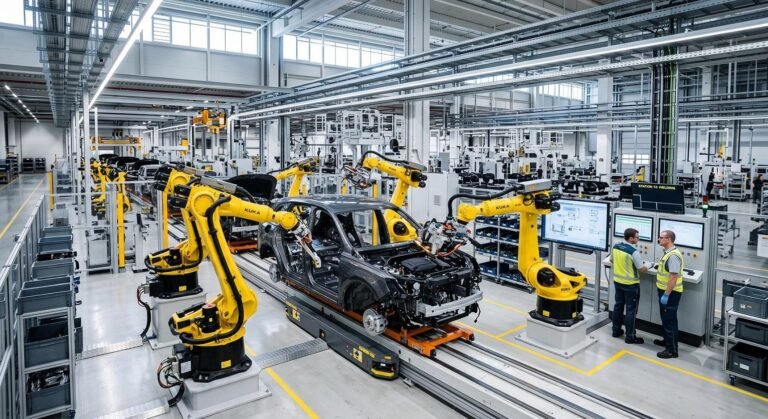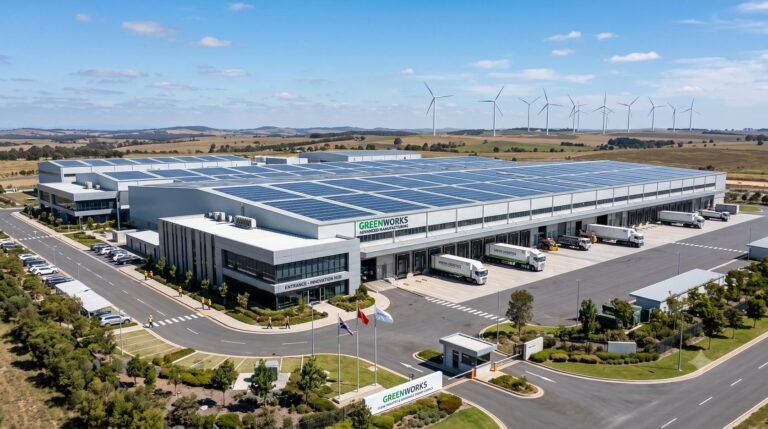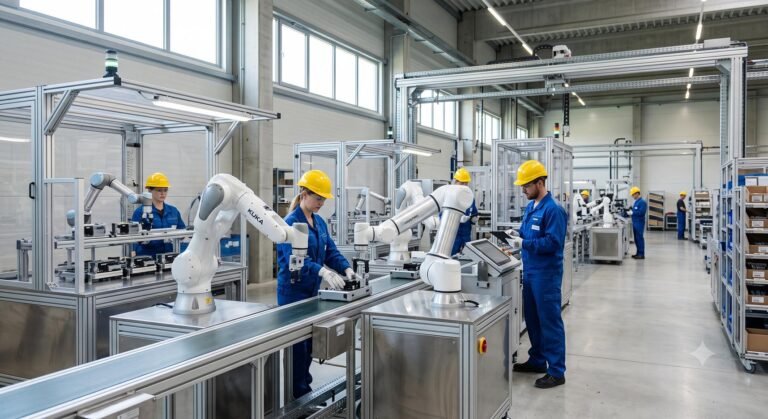

NEW YORK, USA — September 17, 2026 (ACI Newswire) — The global smart manufacturing sector is experiencing rapid expansion as industrial operators deploy advanced digital systems to counter inflation, labor shortages, and supply chain instability. Recent market projections indicate the smart manufacturing market, valued at approximately $394.35 billion in 2025, is on track to exceed $1.33 trillion by 2034. As production facilities shift from isolated pilot programs to scaled enterprise deployments, manufacturers are heavily investing in artificial intelligence, cloud infrastructure, and connected machinery to maintain profitability in a high-cost operating environment.
Market Valuation Approaches the Trillion-Dollar Mark
The financial trajectory of the industrial automation sector reflects a fundamental shift in how heavy industry approaches capital expenditure. Analysts project the global smart manufacturing market will grow at a compound annual growth rate (CAGR) of 14.70% through 2034. This growth is largely driven by the urgent need to stabilize production volumes against fluctuating market demands. The solutions segment, which includes interconnected software platforms and diagnostic tools, is expected to account for 75.50% of the market share by 2026.
Large enterprises currently dominate this investment cycle, representing over 72% of the market. These organizations possess the substantial capital required to overhaul legacy systems and integrate modern architectural frameworks across multiple geographic locations. Their investments primarily target Manufacturing Execution Systems (MES), which document the transformation of raw materials into finished goods in real time, and Supervisory Control and Data Acquisition (SCADA) platforms that provide centralized facility monitoring. By linking these systems together, plant managers achieve total visibility over their supply chain and factory floor operations.
Cloud computing infrastructure also plays a central role in this industrial modernization. Cloud solutions are projected to hold a 65.75% market share by 2026. By migrating data storage and processing off-site, manufacturers can scale their infrastructure dynamically and support remote workforce capabilities established over the past several years. This decentralized approach reduces the physical server footprint required inside harsh industrial environments while ensuring continuous data availability.
Artificial Intelligence Transitions from Pilot to Production
Artificial intelligence is moving beyond experimental applications and functioning as a core driver of business outcomes on the factory floor. According to recent industry surveys, 95% of manufacturers are currently using or evaluating smart manufacturing technologies. Within these digital environments, operators are utilizing machine learning algorithms to process massive volumes of operational data, identify production bottlenecks, and optimize material output.
Generative artificial intelligence has specifically accelerated up the technology priority list for industrial operators. Facility managers deploy these systems to analyze maintenance records, predict equipment failures before they occur, and prescribe exact maintenance schedules. This predictive capability minimizes unplanned downtime, which remains one of the most expensive operational risks for heavy manufacturing facilities.
Furthermore, executives report that digital transformation is no longer an optional strategy. Approximately 90% of industrial leaders state that adopting these digital frameworks is necessary to remain competitive in the current global market. The focus has shifted toward responsible scaling, ensuring that artificial intelligence models integrate directly into existing production functions without disrupting active assembly lines.
Overcoming Inflation and Labor Constraints
Macroeconomic pressures are compelling organizations to rethink their operational models. For consecutive years, inflation and elevated energy costs have ranked as the primary external obstacles to industrial growth. The cost of raw materials and the logistical expenses associated with transporting finished goods force companies to find incremental efficiencies within their production cycles. Smart manufacturing tools provide the exact asset visibility required to identify waste, minimize machine idling, and reduce excess energy consumption on the factory floor.
Simultaneously, the manufacturing sector faces a persistent shortage of skilled labor. Experienced machine operators and maintenance technicians are aging out of the workforce, and companies consistently struggle to attract younger talent with the necessary technical proficiencies. Rather than completely replacing human workers, digital automation serves to augment the existing labor pool and increase individual productivity.
Current data contradicts the long-held assumption that industrial automation results in widespread job displacement. An estimated 94% of manufacturers expect to maintain or grow their workforce as a result of adopting smart technology. Organizations are transitioning employees away from manual, physically demanding, and repetitive tasks. Instead, these workers are being reassigned to operational roles requiring complex problem-solving, data analysis, and digital system management.
Bridging the IT and OT Divide Elevates Cyber Risk
As physical machinery becomes increasingly connected to digital networks, the traditional barrier between Information Technology (IT) and Operational Technology (OT) is dissolving. Modern factory floors rely on smart devices and sensors that continuously transmit diagnostic data back to centralized enterprise systems. While this interconnectivity provides immense operational benefits, it also vastly expands a facility’s digital attack surface.
Consequently, cybersecurity has emerged as a critical concern for industrial operators, breaking into the top five external risks for the manufacturing sector. Malicious actors frequently target the manufacturing industry due to the high financial cost of operational downtime. A successful ransomware attack on an industrial control system can halt production entirely, causing millions of dollars in losses and severe supply chain delays.
To mitigate these vulnerabilities, companies are moving away from treating security as an IT add-on. Resilience and digital security are now strict requirements integrated directly into the initial architecture of production environments. Facility managers are deploying advanced network segmentation and continuous monitoring tools to isolate critical machinery from broader corporate networks.
Regional Shifts: Asia-Pacific and North America Lead Adoption
Geographic adoption of industrial automation remains concentrated in regions with established manufacturing bases and substantial government incentives. The Asia-Pacific region dominates the global landscape, capturing approximately 34.40% of the market share. Countries within this region are heavily investing in advanced robotics, electronics manufacturing, and automotive assembly lines to maintain their status as global production hubs.
In North America, the drive to build resilient, localized supply chains is accelerating digital investments. Following several years of logistical disruptions, major corporations are reshoring production facilities back to the United States. The U.S. smart manufacturing market is projected to reach $186.87 billion by 2032. These newly constructed domestic facilities are being designed natively with advanced digital infrastructure, avoiding the complexities of retrofitting legacy plants.
The global rollout of 5G access networks will further expedite this regional growth. High-speed, low-latency connectivity allows for real-time data processing at the industrial edge. Telecommunications providers estimate that fifth-generation wireless technology could add $740 billion to the global manufacturing gross domestic product by 2030.
ESG and Energy Efficiency Drive Technology Investments
Environmental, Social, and Governance (ESG) mandates are increasingly influencing capital allocation within the industrial sector. Improving operational efficiency is the primary reason manufacturers are pursuing sustainability initiatives. Currently, 98% of manufacturers report having an ESG policy in place, with nearly half of those implementing company-wide formalized frameworks. Investors and regulatory bodies now expect heavy industries to actively manage and reduce their carbon footprint.
Energy consumption represents a massive variable cost for process industries such as chemical refinement, metallurgy, and commercial pulp production. Smart manufacturing systems deploy advanced metering and real-time monitoring to track energy usage across individual production cells. By identifying machinery that draws excess power during idle periods or operates inefficiently, facility managers can significantly reduce their baseline energy expenses.
Additionally, Product Lifecycle Management (PLM) software allows engineers to design products with sustainability in mind from the initial concept phase. Manufacturers can simulate material usage and supply chain logistics virtually, ensuring that the physical production process minimizes raw material waste. This digital-first approach prevents costly physical prototyping errors and ensures that the final manufacturing process aligns with corporate sustainability targets.
Industry Context and the Path Forward
Despite the clear operational benefits, the transition toward fully digitized production environments presents substantial financial barriers. High initial capital investments remain the most significant impediment to market expansion. Procuring intelligent hardware, licensing enterprise software, and hiring specialized integration consultants requires upfront capital that can strain smaller operations.
Small and medium-sized enterprises (SMEs) often struggle to justify these initial costs, particularly when navigating uncertain economic conditions. Furthermore, organizations frequently face a lack of clear information regarding which specific technologies will yield the highest return on investment for their unique operational requirements.
Moving forward, the industry is likely to see a tiered approach to implementation. Operators will prioritize targeted investments that solve immediate bottlenecks—such as automated quality control or localized predictive maintenance—before attempting comprehensive facility overhauls.
The sustained growth of the smart manufacturing sector reflects a pragmatic response to persistent global economic challenges. Industrial operators are investing heavily in interconnected software, artificial intelligence, and automated hardware to improve production resilience and protect profit margins. As global markets approach a projected $1.33 trillion valuation by 2034, the successful execution of digital transformation strategies will increasingly determine the competitive hierarchy of the global manufacturing industry.
About ACI Newswire
ACI Newswire is a digital press release distribution network serving corporate communications professionals, public relations firms, and financial institutions. We syndicate corporate announcements, earnings reports, and industry analysis to global media outlets and financial databases. ACI Newswire focuses on providing clear, direct corporate communications solutions for publicly traded and private organizations worldwide.
Suggested Media Contact:
ACI Newswire
contact@acinewswire.com