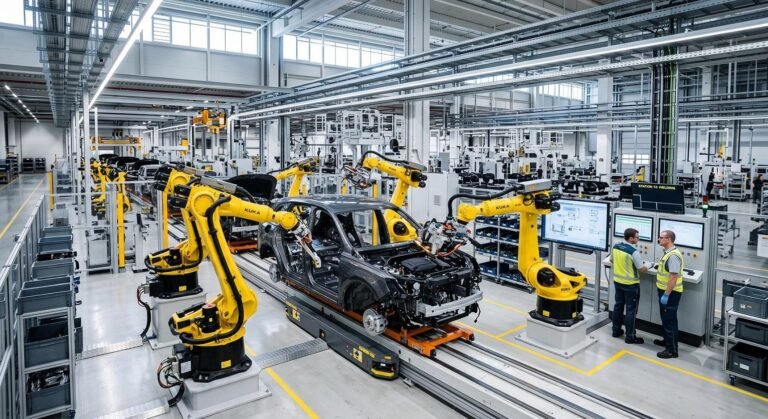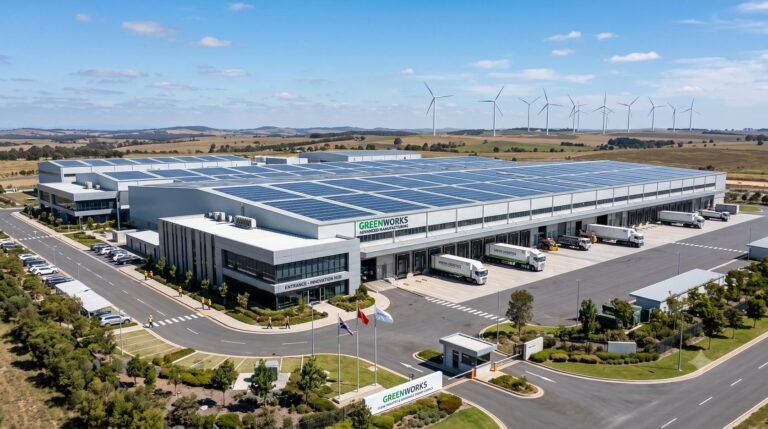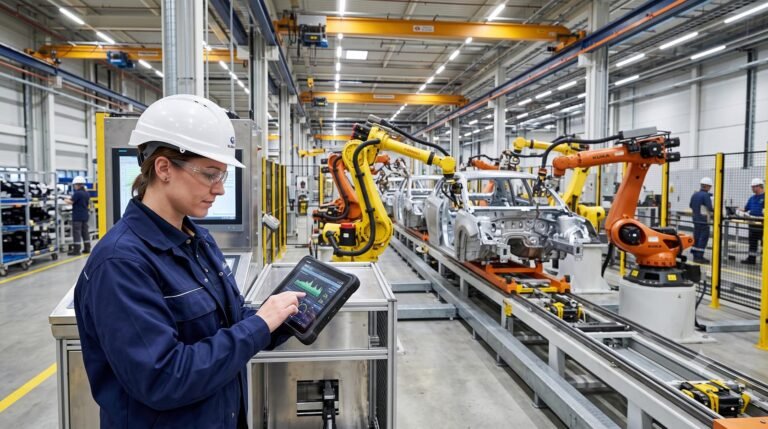

LONDON, UNITED KINGDOM — September 17, 2026 (ACI Newswire) – Global manufacturing firms are aggressively deploying physical artificial intelligence and advanced industrial robotics to counter rising labor costs and mitigate supply chain vulnerabilities. As the industrial automation market scales toward an estimated $504.38 billion by 2033, facility operators report substantial improvements in production efficiency and asset utilization. Recent industry data indicates that facilities integrating these connected systems observe productivity increases of up to 30 percent, prompting widespread adoption across non-traditional sectors.
The Financial Case for Physical Artificial Intelligence
Manufacturers allocate capital to physical AI systems, focusing on applications that deliver immediate and quantifiable returns on investment. According to a 2026 Deloitte analysis, AI-driven predictive maintenance systems generate a 250 percent to 300 percent return on investment within two years of implementation. These systems monitor equipment health in real time, identifying potential mechanical failures before they disrupt operations. Consequently, operators reduce unplanned downtime by up to 50 percent, maintaining consistent production schedules and reducing overhead.
Collaborative Robots Expand Beyond Automotive Assembly
Historically, the automotive industry dominated industrial robotics, representing the bulk of factory installations. However, market data from 2025 shows that 70 percent of collaborative robot, or cobot, orders originated from non-automotive sectors. Electronics contract manufacturers, food processors, and pharmaceutical companies now deploy these systems for tasks requiring high precision and adaptability. Unlike traditional heavy industrial robots, cobots operate alongside human workers without physical safety cages. This operational flexibility allows facility managers to reconfigure production lines quickly, accommodating changing consumer demands and increasingly short product lifecycles.
Autonomous Mobile Robots Optimize Internal Logistics
Internal material handling remains a labor-intensive component of traditional manufacturing. To address this, plant managers are deploying autonomous mobile robots (AMRs) to manage facility logistics. These robots handle material transport, parts delivery, sorting, and dynamic inventory management across the factory floor. By navigating complex environments and rerouting in real time when obstacles appear, AMRs ensure assembly stations remain supplied without human intervention. Analysts project the broader logistics sector will expand at a 14.2 percent compound annual growth rate through 2029, driven heavily by these autonomous transport systems.
Supply Chain Resilience and Reshoring Initiatives
Geopolitical uncertainties and escalating transportation costs compel multinational companies to localize production. Automation makes reshoring financially viable by offsetting higher domestic labor expenses. Average hourly manufacturing wages in the United States reached $34 in 2025 and are expected to climb further, accelerating the financial justification for automated systems. Concurrently, government incentives stimulate domestic manufacturing investments. In India, for example, the Union government disbursed substantial funds under production-linked incentive programs, prompting firms like Mitsubishi Electric to inaugurate a $2.2 billion factory automation plant to serve local demands.
Lower Hardware Costs Accelerate SME Adoption
While large multinational corporations led early automation efforts, small and medium-sized enterprises (SMEs) now represent a rapidly expanding customer segment. A global oversupply of industrial sensors pushed average prices down 15 to 20 percent between 2024 and 2025. This price correction stimulated a 35 percent jump in sensor shipments to mid-sized factory operators. Consequently, 38 percent of surveyed mid-sized manufacturing firms initiated brownfield digital retrofits in 2025, up from 22 percent the previous year. Pharmaceutical sites utilized these cost-effective digital sensors with self-diagnostics to cut false alarms by 40 percent, feeding cleaner data into their predictive models.
AI-Powered Quality Inspection and Defect Reduction
In addition to mechanical operations, automated systems are replacing manual quality control processes. AI-powered machine vision systems inspect products on assembly lines at speeds impossible for human operators to match. These high-speed cameras and sensors identify microscopic defects, color variations, and structural inconsistencies in real time. Companies utilizing automated quality inspection report an approximate 250 percent return on investment, primarily driven by a drastic reduction in scrapped materials and customer returns. By catching defects early in the production cycle, manufacturers prevent costly downstream processing of flawed components.
Edge Computing and Decentralized Control Solutions
Modern factory architectures are moving away from centralized control rooms toward decentralized networks. Edge computing allows data processing to occur directly at the machine level, rather than transmitting information back to a central server. This localized processing significantly reduces latency, enabling split-second operational adjustments crucial for high-speed manufacturing. According to industry assessments, hybrid configurations that balance local edge computing with broader cloud analytics are advancing rapidly due to their high reliability. This infrastructure allows automated machines to operate autonomously during network disruptions, ensuring continuous factory output.
Mitigating Cybersecurity Vulnerabilities in Connected Factories
Increased connectivity within automated factories introduces new operational risks. Integrating legacy industrial control systems with cloud-based analytics expands the potential attack surface for digital threats. The 2025 cyberattack on a major automotive manufacturer, which halted global production for five weeks and resulted in an estimated $260 million loss, underscores the necessity of stringent security protocols. Consequently, manufacturers now mandate comprehensive cybersecurity frameworks alongside physical automation investments, prioritizing network segmentation and continuous monitoring to protect operational technology.
Market Trajectory and Industry Context
The global industrial automation sector reached a valuation of $226.76 billion in 2025. Driven by a compound annual growth rate of 10.5 percent, market analysts project the total sector will exceed $504 billion by 2033. The physical AI subsegment exhibits even faster expansion, projected to grow at a 32.53 percent compound annual growth rate from $5.23 billion in 2025 to nearly $50 billion by 2033. Asia currently accounts for 74 percent of global industrial robot installations, followed by Europe at 16 percent and the Americas at 9 percent. Annual global deployments of industrial robots are expected to surpass 700,000 units by 2028.
Conclusion
As labor shortages persist and supply chain optimization remains an operational priority, the transition toward automated manufacturing represents a fundamental industrial shift. Manufacturers across diverse sectors continue to integrate robotics, predictive analytics, and digital simulation to maintain competitive advantages. While initial capital expenditures are substantial, the measurable improvements in production efficiency, quality control, and downtime reduction support the ongoing expansion of the industrial automation market.
About ACI Newswire
ACI Newswire is an independent business communications platform distributing financial, corporate, and sector-specific news to global markets. We provide editorial coverage, corporate announcements, and industry analysis for media professionals, institutional investors, and business leaders. Operating across major financial hubs, ACI Newswire focuses on delivering clear, objective reporting on market trends, technological developments, and macroeconomic shifts.
Media Contact
ACI Newswire
contact@acinewswire.com