
NEW YORK, UNITED STATES — August 8, 2026 (ACI Newswire) — Global enterprises are sharply increasing capital expenditures on cloud computing infrastructure as the maturation of artificial intelligence workloads and complex data demands outpace existing corporate technology capabilities.
Throughout the current fiscal year, organizations across the financial, healthcare, and retail sectors have initiated sweeping hardware and network upgrades. Rather than maintaining standard virtual server environments, companies are provisioning specialized, high-performance computing clusters designed specifically for data-intensive processing. This shift represents a structural change in enterprise IT budgeting, moving away from temporary digital modernization projects toward permanent, heavy-duty cloud integration.
Industry data indicates that total public cloud spending is expanding at a double-digit rate, driven largely by infrastructure-as-a-service (IaaS) and platform-as-a-service (PaaS) models. As artificial intelligence transitions from experimental pilot programs into core production environments, the required computing power has forced chief information officers to reevaluate their foundational network architecture.
AI Transition Forces IT Budget Reallocations
The primary catalyst for this infrastructure expansion is the widespread deployment of machine learning and large language models. These technologies require massive computational resources, particularly specialized graphics processing units (GPUs) and custom silicon, which are difficult and expensive to maintain in on-premises data centers.
To bridge this gap, businesses are turning to major cloud service providers to lease advanced computing power. This transition requires significant upfront investment in cloud architecture redesign. Companies are restructuring their databases to feed information securely into AI models, requiring high-bandwidth networking and low-latency storage solutions.
Analysts tracking enterprise IT budgets note that infrastructure spending is crowding out other technology investments. Organizations are reallocating funds previously designated for traditional software applications toward heavy compute resources. The consensus among corporate technology officers is that failing to secure adequate cloud computing capacity now will result in severe operational bottlenecks in the coming years.
Hyperscalers Respond to Capacity Constraints
In response to the corporate demand for higher compute thresholds, the industry’s dominant hyperscalers—namely Amazon Web Services, Microsoft Azure, and Google Cloud—are executing massive capital expenditure programs. These providers are building new data center campuses across North America, Europe, and Asia-Pacific regions.
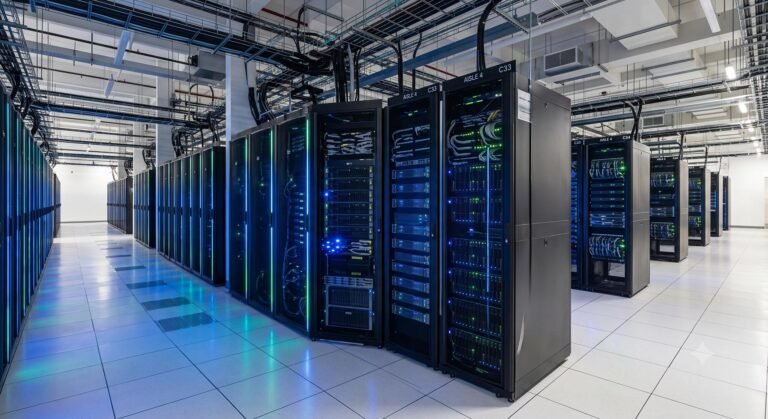
These new facilities look remarkably different from the data centers built a decade ago. They feature reinforced structural designs to support the physical weight of dense AI server racks. Furthermore, because high-performance processors generate intense heat, providers are retrofitting facilities with advanced liquid cooling systems.
For enterprise clients, this massive provider-side investment translates into higher service reliability but also introduces new pricing dynamics. As the hyperscalers spend billions to secure energy access and real estate for new data centers, corporate customers are locking into long-term infrastructure contracts to guarantee their access to scarce GPU capacity.
The Shift Toward Sovereign and Hybrid Cloud Models
While public cloud infrastructure is growing, enterprises are not abandoning their private hardware entirely. Regulatory pressures, particularly concerning data privacy and national security, have fueled a parallel surge in sovereign and hybrid cloud architectures.
In the European Union and parts of Asia, strict data localization laws require companies to keep consumer data within specific geographic borders. To comply, multinational corporations are investing heavily in sovereign cloud regions. These localized infrastructure nodes are operated by domestic partners but utilize the software architectures of the major global tech firms.
Simultaneously, the hybrid cloud model has become the standard operating procedure for heavily regulated industries. Financial institutions and healthcare providers are maintaining sensitive customer data on proprietary, physical servers while utilizing public cloud infrastructure strictly for anonymous, heavy-duty data processing. Building the secure network bridges between these two environments accounts for a significant portion of current enterprise IT spending.
Cost Optimization Replaces Growth at All Costs
The rapid expansion of cloud infrastructure has exposed many organizations to unpredictable and escalating billing cycles. In previous years, corporate departments often provisioned cloud resources independently, leading to bloated networks and redundant storage.
To combat this, the discipline of FinOps (financial operations) has become a mandatory component of enterprise cloud strategies. Companies are investing in third-party monitoring infrastructure to track compute usage by the minute. IT departments are auditing their active virtual machines, terminating idle resources, and right-sizing their computing instances to match actual workload requirements.
This focus on cost optimization means that while overall investment in cloud computing is rising, the nature of the spending is highly scrutinized. Chief financial officers are requiring detailed return-on-investment projections for new cloud architecture. The current spending wave is not indiscriminate; it is highly targeted toward infrastructure that directly supports revenue-generating services or critical operational efficiency.
Security and Edge Computing Drive Secondary Spending
As cloud networks become more complex and decentralized, the surface area for potential cyber threats has expanded. Consequently, a substantial portion of new cloud infrastructure investment is directed toward cybersecurity and zero-trust network architecture. Enterprises are embedding automated security protocols directly into their cloud development pipelines.
Furthermore, industries heavily reliant on physical logistics—such as manufacturing, shipping, and physical retail—are driving investment into edge computing. Rather than sending data back to a centralized cloud server hundreds of miles away, these companies are deploying micro-infrastructure at the edge of their networks.
By processing data on factory floors or within distribution centers, organizations reduce latency and bandwidth costs. This localized infrastructure still connects to the central cloud for long-term storage and machine learning model training, creating a multi-tiered infrastructure model that requires continuous capital investment to maintain.
Energy Constraints and Sustainable Infrastructure
The environmental impact of expanding cloud operations has become a board-level concern for major corporations. The high-density server racks required for advanced computing consume vast amounts of electricity. In several major technology hubs, the local power grids are struggling to meet the capacity demands of new data center proposals.
Enterprises are now factoring sustainability metrics into their cloud infrastructure investments. Many are prioritizing service providers that can guarantee carbon-neutral operations through the direct purchase of renewable energy. Corporate clients are demanding detailed reporting on the water usage and carbon footprint associated with their specific cloud workloads.
This pressure is forcing cloud providers to innovate their infrastructure designs, investing in highly efficient power routing and waste-heat recycling systems. For the enterprise customer, migrating workloads to these newer, hyper-efficient cloud regions is a capital-intensive process, but one that is increasingly necessary to meet corporate environmental, social, and governance (ESG) targets.
Sector Breakdown: How Industries Are Allocating Cloud Capital
The broader macroeconomic trend of increased cloud investment takes different forms depending on the industry. Sector-specific requirements are dictating exactly what type of infrastructure companies purchase.
Financial Services: Banks and trading firms are prioritizing ultra-low-latency networks and encrypted data enclaves. Their cloud investments are heavily skewed toward maintaining compliance across multiple international jurisdictions. Modernizing legacy mainframe systems into cloud-native environments remains a massive, multi-year financial commitment for tier-one banks.
Healthcare and Life Sciences: The medical sector is processing unprecedented volumes of unstructured data, ranging from high-resolution medical imaging to complex genomic sequencing. Healthcare providers are investing in cloud storage architectures that offer long-term archiving capabilities combined with immediate retrieval speeds for emergency clinical care.
Retail and E-commerce: Retailers are utilizing cloud infrastructure to support real-time inventory tracking and dynamic pricing engines. Their investments are heavily focused on scalable infrastructure that can instantly absorb massive traffic spikes during seasonal shopping events without degrading the consumer experience.
Industry Outlook: Moving Beyond Lift-and-Shift
The era of the “lift-and-shift” strategy—where companies simply moved existing software applications from a local server room to a public cloud—is over. Enterprises recognize that older software architectures cannot fully utilize the speed or scale of modern cloud infrastructure.
As a result, current infrastructure spending is deeply intertwined with application modernization. Organizations are breaking down monolithic software into microservices, deploying them in software containers, and managing them through systems like Kubernetes. This cloud-native approach ensures that applications can scale horizontally, drawing computing power only when actively needed.
Rebuilding software to be cloud-native requires specialized engineering talent and significant time, acting as a secondary driver for IT budget increases. As companies commit to these big structural changes, they are cementing their reliance on advanced cloud computing for the foreseeable future.
Conclusion
The rising trajectory of enterprise cloud infrastructure investment reflects a fundamental realignment of corporate priorities. Driven by the computational demands of artificial intelligence, the complexities of hybrid work environments, and the need for rigorous data security, businesses are committing unprecedented capital to their network architectures. As major hyperscalers build out the physical facilities to support this demand, corporate IT departments are focused on managing costs, optimizing workloads, and modernizing legacy systems. The resulting technology landscape is one where advanced, high-performance cloud infrastructure serves as the non-negotiable foundation for global business operations.
About ACI Newswire
ACI Newswire is a global press release distribution and corporate news platform. We deliver business announcements, financial disclosures, and market updates directly to media outlets, financial terminals, and professional databases worldwide. Serving public companies, private enterprises, and communications agencies, ACI Newswire provides a reliable channel for distributing material news to journalists, investors, and industry stakeholders.
Media Contact:
ACI Newswire
contact@acinewswire.com