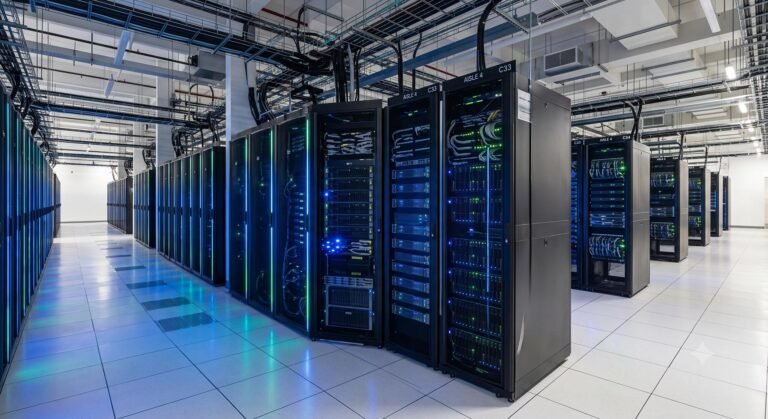

NEW YORK, UNITED STATES — September 25, 2026 (ACI Newswire) — Global enterprise adoption of artificial intelligence continues to expand past initial pilot phases, with corporate spending on AI infrastructure and software projected to reach $632 billion by 2028. Recent industry data indicates that nearly nine in ten organizations now utilize artificial intelligence in at least one business function, reflecting a broader shift toward integrating automation and machine learning into core operations. As corporate leaders evaluate the operational returns on their initial technology investments, the focus has shifted toward building resilient data architectures, resolving talent shortages, and deploying specialized applications that generate measurable financial value.
Beyond Experimentation: Scaling AI in Enterprise
Initial corporate deployments of artificial intelligence often involved isolated experiments and single-use chatbots. Over the past twelve months, larger organizations have actively moved toward broader operational integration. According to the McKinsey Global Survey 2026, 44 percent of enterprise respondents report scaling AI across their operations, up from 38 percent in the previous year.
This expansion is primarily driven by large multinational corporations equipped with substantial capital and existing data infrastructure. Fifty-four percent of organizations generating over $1 billion in annual revenue have moved AI systems into production scale. In contrast, adoption among smaller enterprises remains relatively stagnant, with approximately 22 percent of smaller firms reporting scaled deployment. Analysts suggest that smaller organizations often lack the necessary capital to rebuild their internal databases, limiting their ability to deploy autonomous systems effectively.
The transition from pilot programs to full-scale deployment requires a fundamental restructuring of internal workflows. Companies that successfully scale these technologies establish centralized governance frameworks to monitor algorithmic output and manage compliance risks. Corporate executives are increasingly requiring concrete evidence of return on investment before authorizing further software expenditures, pushing IT departments to prioritize applications that directly reduce operational costs or accelerate revenue generation.
Expanding Enterprise Budgets and Infrastructure Investment
The financial commitment to machine learning systems reflects a transition from specialized research to core corporate infrastructure. The International Data Corporation (IDC) forecasts that global enterprises will spend $307 billion on AI solutions in 2025, with total annual investments expected to surpass $632 billion by 2028. This capital allocation involves substantial investments in cloud computing, specialized hardware, and proprietary data processing facilities.
During the fourth quarter of 2025 alone, worldwide spending on artificial intelligence infrastructure reached nearly $90 billion, representing a 62 percent year-over-year increase. Corporations are directing a significant portion of their technology budgets toward acquiring the server capacity necessary to train and operate complex models. Consequently, major cloud service providers report unprecedented demand for computational resources, leading to extended wait times for hardware procurement in certain regions.
Beyond hardware, enterprise spending is heavily concentrated on data management platforms. Industry analysts estimate that data management and processing investments accounted for over $31 billion globally in recent capital flows. Organizations recognize that effective machine learning applications require rigorous data classification, secure storage, and real-time processing capabilities. This realization has triggered a corresponding surge in demand for enterprise data architecture services and specialized consulting.
Sector-Specific Adoption Patterns
Implementation rates and primary use cases vary significantly by sector. Information technology, professional services, and finance currently lead the market in deployment speed and integration depth. Data from the United States Census Bureau indicates that the information sector reached a 43.5 percent adoption rate in late 2026, followed closely by professional and scientific services at 43.3 percent.
Financial institutions remain aggressive investors in automation, utilizing algorithmic systems for real-time risk assessment, automated fraud detection, and high-frequency quantitative trading. Banks are also deploying advanced natural language processing tools to automate client communication and streamline regulatory compliance reporting. In the healthcare sector, the Stanford AI Index 2026 noted a significant rise in AI applications for clinical documentation, diagnostic reasoning, and medical imaging. Medical administrators use these tools to reduce administrative overhead and accelerate patient intake processes.
Conversely, traditional manufacturing and industrial sectors focus their investments on predictive maintenance and supply chain logistics. Automotive and aerospace companies use agentic AI to manage inventory forecasting and optimize global shipping routes. By analyzing historical supply chain disruptions and real-time weather data, these manufacturers can preemptively adjust their procurement schedules to minimize factory downtime.
The Build-Versus-Buy Shift in Corporate IT
The proliferation of agentic AI and automated coding tools is altering how companies procure enterprise software. Rather than licensing expensive, pre-packaged platforms from external vendors, a growing contingent of organizations is developing proprietary applications in-house. Software coding agents enable smaller teams of internal developers to write, test, and deploy code at a substantially accelerated pace.
According to recent benchmark surveys, 32 percent of organizations have canceled or avoided purchasing at least one commercial software product because their internal teams built the required functionality using AI coding assistants. This shift toward internal development is most prominent within the technology, healthcare, and energy sectors. Corporate IT directors report that building custom applications allows them to maintain stricter control over their proprietary data and avoid restrictive vendor lock-in contracts.
This trend presents a direct structural challenge to traditional software-as-a-service (SaaS) providers. As client organizations realize they can replicate basic relationship management or inventory tracking functionalities internally, SaaS vendors are forced to justify their recurring licensing fees. To maintain market share, software providers are embedding highly specialized, industry-specific analytical capabilities into their platforms that remain too complex for internal IT teams to replicate independently.
Addressing the Adoption-Scaling Gap
Despite broad baseline adoption, comprehensive enterprise deployment remains structurally challenging. The Stanford AI Index 2026 highlights a severe discrepancy between initial usage and full-scale production. While 88 percent of organizations utilize AI in some capacity, fewer than 10 percent have fully scaled an AI system across a single business function.
Industry analysts attribute this adoption-scaling gap directly to underlying data architecture constraints rather than model capability limits. Large language models and predictive algorithms are technically proficient, yet they often fail when integrated into corporate networks due to fragmented data sources, inconsistent governance standards, and missing lineage. When the data feeding an autonomous system is outdated, siloed, or poorly labeled, the system cannot produce reliable outputs at scale.
To bridge this gap, chief technology officers are redirecting resources away from purchasing new software applications and toward repairing their fundamental data infrastructure. Enterprises are undertaking massive data consolidation projects, aiming to unify disparate records across human resources, sales, and logistics departments. Until these foundational data architecture issues are resolved, analysts predict that the majority of corporate automation initiatives will remain confined to limited pilot phases.
Workforce Implications and Talent Scarcity
The transition toward automated enterprise processes places acute pressure on corporate recruitment and human resources departments. Sourcing personnel qualified to build, monitor, and manage machine learning models remains exceedingly difficult on a global scale. Global staffing reports indicate that AI model and application development is currently the most difficult technical skill set for employers to secure.
Approximately 20 percent of employers globally cite AI development as their primary hiring challenge. In regions such as Japan, the talent shortage is even more pronounced, with a vast majority of employers reporting severe difficulties in filling specialized engineering roles. The scarcity of qualified machine learning engineers, data scientists, and systems architects has driven compensation packages for these roles to historic highs.
To mitigate this talent deficit, companies are adopting hybrid workforce strategies. Corporations are allocating significant capital toward upskilling existing employees, training software engineers to utilize automated coding tools to increase their individual output. Furthermore, organizations are increasingly partnering with specialized offshore engineering firms and third-party talent networks to source vetted data engineers, bypassing the competitive domestic labor market entirely.
Market Impact and Strategic Realignment
The continuous deployment of algorithmic systems is forcing a broader strategic realignment across the global business landscape. Companies are aggressively assessing their competitive positioning, evaluating whether their long-term advantage lies in proprietary datasets, specialized hardware access, or the speed of application deployment. In highly competitive sectors, executives recognize that delayed adoption may result in permanent structural disadvantages regarding operational efficiency and cost management.
The macroeconomic implications extend to global capital markets and venture funding. Global private investment in AI technologies continues to rise, with significant capital flowing into data management firms and infrastructure providers. Investors are closely monitoring which enterprises can successfully translate technology expenditures into measurable margin expansion and revenue growth.
Moreover, regulatory frameworks are evolving in tandem with enterprise adoption. As corporations integrate autonomous systems into critical functions such as clinical diagnostics and financial risk assessment, international regulators are demanding stricter oversight. Corporate boards are actively establishing internal ethics committees and compliance protocols to ensure their algorithmic deployments adhere to emerging privacy and security mandates.
Neutral Conclusion
Enterprise AI adoption has matured from theoretical exploration and localized experimentation into substantial capital investment and functional deployment. While the overwhelming majority of global organizations now employ basic AI tools, a significant divide persists between early usage and enterprise-scale integration. Corporate spending reflects a strategic pivot toward robust data infrastructure, specialized hardware, and internal talent development. Moving forward, market leadership will likely depend on an organization’s capacity to resolve underlying data architecture limitations, secure specialized technical talent, and accurately align automated systems with established business objectives.
About ACI Newswire
ACI Newswire is a global distributor of financial, business, and corporate news. Operating across major financial hubs, ACI Newswire connects public and private companies, financial institutions, and research organizations with global media outlets and industry stakeholders. The platform provides comprehensive press release distribution and corporate communications services, facilitating the timely dissemination of market-moving information to journalists, investors, and the broader business community.
Media Contact
ACI Newswire
contact@acinewswire.com