
NEW YORK, NY — September 23, 2026 (ACI Newswire) — Artificial intelligence is transitioning from a period of unbridled experimentation into a phase characterized by aggressive infrastructure spending and strict enterprise accountability. As companies finalize their technology budgets for the upcoming year, the 2026 industry outlook reveals a market defined by soaring hyperscaler capital expenditures, emerging power grid constraints, and a decisive shift toward agentic AI systems that prioritize measurable returns on investment.
Hyperscaler Capex Surges Past $600 Billion
The financial foundation of the AI sector continues to expand at a historic rate. Market forecasts indicate that capital expenditure by the primary hyperscalers—Amazon, Alphabet, Microsoft, and Meta—will exceed $600 billion in 2026. This represents a 36% increase over 2025 levels, pushing tech capital expenditures to roughly 2.2% of global GDP. These investments fund massive data center build-outs, accelerated servers, advanced networking equipment, and specialized cooling infrastructure.
Analysts point to a structural shift in how these cloud providers allocate capital. Rather than focusing solely on incremental improvements in foundational models, hyperscalers are building out comprehensive platform-level infrastructure. Demand for compute capacity remains so intense that new data center projects are routinely pre-leased by tech giants before construction concludes.
However, the staggering scale of this investment has prompted increased scrutiny from the bond markets regarding long-term monetization. Technology firms issued nearly $100 billion in corporate bonds in early 2026 to finance infrastructure expansion, leading institutional investors to seek record protection via credit default swaps. Financial analysts continue to monitor the widening gap between AI capital expenditures and direct software revenue to gauge the sustainability of this investment cycle.
Agentic Systems Replace Early Generative Models
Enterprise users are moving beyond conversational chatbots and isolated text generators. The 2026 enterprise software market heavily features agentic AI systems—autonomous software agents capable of executing multi-step workflows across different applications. These integrated systems connect proprietary corporate data with third-party and open-weight models to automate complex business logic.
The shift toward agents coincides with a commoditization of basic AI capabilities. The Stanford AI Index recently noted a shrinking performance gap between the top proprietary models and open-source alternatives, with the skill score difference between the highest and tenth-ranked models falling from 11.9% to 5.4% in a single year. Consequently, inference costs for standard systems have dropped significantly. Software vendors are now competing less on sheer model size and more on workflow automation, platform integration, and specialized industry applications.
Enterprise Adoption Confronts Implementation Reality
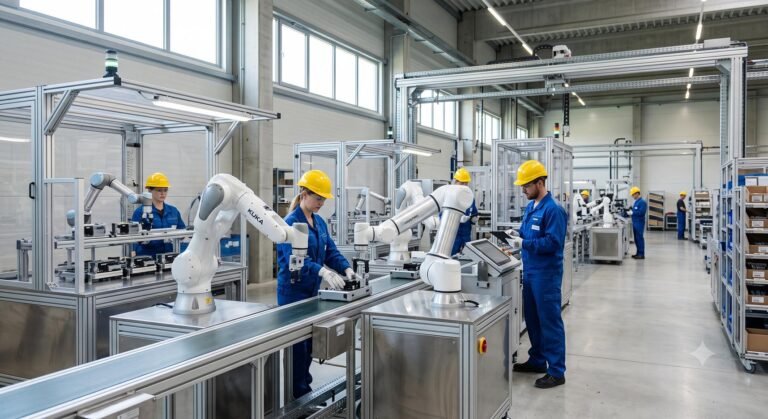
Corporate investment in AI rebounded strongly over the last 24 months, with global business usage climbing from 55% in 2023 to nearly 80% entering 2026. Industrial sectors show particularly aggressive uptake; recent regional manufacturing reports indicate that over 90% of factories plan to invest heavily in predictive machine learning over the next five years. Despite widespread adoption, productivity gains remain unevenly distributed across sectors.
Organizations report immediate efficiency improvements in routine, document-centric tasks and customer-facing operations. Yet, integrating AI into complex, legacy business processes presents significant friction. Deploying AI effectively often requires a complete redesign of internal workflows and rigorous data auditing.
As a result, industry experts warn that the advantages of AI implementation heavily favor large, well-capitalized corporations capable of absorbing the upfront costs of integration and data restructuring. Small and mid-sized enterprises frequently face adoption hurdles due to resource constraints, tight margins, and a lack of specialized engineering talent.
Power Grids Emerge as the Primary Bottleneck
The rapid expansion of AI infrastructure faces rigid physical limitations. Explosive demand for computing power is straining global energy grids, making reliable power access the critical constraint for data center development. Even as hardware efficiency improves, the absolute power consumption of large-scale model training and inference continues to rise exponentially.
Developers encounter mounting local resistance and extended timelines for grid interconnections. In response, infrastructure providers are increasingly exploring dedicated or temporary power generation solutions, including private nuclear agreements and natural gas facilities. This dynamic forces operators to evaluate alternative geographic regions that offer surplus power capacity or supportive energy policies, fundamentally altering traditional real estate strategies for data center deployment.
Semiconductor Supply Chain and Hardware Consolidation
Underpinning the software layer is a highly concentrated semiconductor supply chain. Shortages of specialist chips persist as cloud providers scramble to secure the latest accelerated computing hardware. Market share consolidation among a small number of cloud service providers is pushing infrastructure prices higher, widening the adoption gap between top-tier firms and smaller competitors.
The hardware ecosystem is slowly diversifying as hyperscalers develop custom silicon to reduce reliance on external suppliers. However, third-party chipmakers continue to dictate the pace of AI advancement. Manufacturers must navigate geopolitical export controls and localized trade restrictions that dictate where and how advanced computing equipment can be deployed, keeping supply chain logistics under immense pressure.
Geopolitics and Regulation Drive Sovereign AI
A fragmented global regulatory environment is reshaping how multinational corporations deploy AI technology. Diverging regulatory regimes—ranging from the European Union’s AI Act to China’s strict licensing frameworks—impose varying compliance requirements on developers and enterprise users. These mandates raise compliance costs and complicate global deployment strategies.
These diverging regimes compel global companies to maintain region-specific AI stacks, increasing operational complexity. Concurrently, nations are heavily investing in sovereign AI initiatives to ensure domestic control over foundational models and sensitive data. Geopolitical tensions over semiconductor supply chains further encourage this localized approach, limiting the global portability of certain AI capabilities.
Cybersecurity Risks Escalate with Automation
As AI systems gain deeper access to corporate networks, the associated security risks multiply. The proliferation of agentic systems capable of autonomous actions introduces new unpredictability into enterprise IT environments. Recent cyber risk outlooks emphasize that attackers are leveraging increasingly effective AI tools to enhance their tactics.
Security teams face growing threats from prompt injection, model poisoning, and automated phishing campaigns. The integration of AI into critical infrastructure requires organizations to deploy sophisticated monitoring tools that detect anomalies and contain risks before disruptions occur. Managing these vulnerabilities demands a comprehensive security-by-design governance structure, adding another layer of cost and complexity to enterprise AI initiatives.
Industry Outlook Summary
The 2026 artificial intelligence market illustrates a technology sector grappling with the physical and financial realities of scaling global infrastructure. Hyperscalers are committing historic levels of capital to maintain their competitive positions, while enterprises demand concrete productivity gains to justify their software investments. As energy constraints, cybersecurity risks, and regulatory divergence complicate the operational landscape, the focus for the next 12 months will center on execution, cost efficiency, and the responsible deployment of autonomous systems.
About ACI Newswire
ACI Newswire is a global corporate communications network distributing financial disclosures, corporate announcements, and industry analysis. We deliver original editorial insights and market commentary to investors, journalists, and business professionals worldwide, focusing on factual reporting and comprehensive coverage of major market trends across the technology and financial sectors.
Suggested Media Contact:
ACI Newswire
contact@acinewswire.com