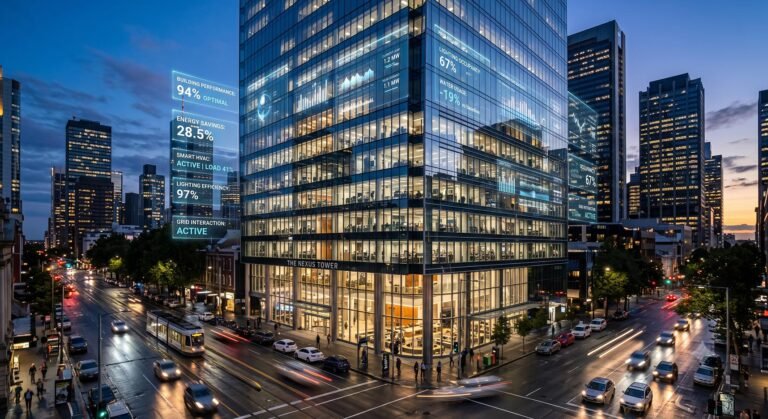

NEW YORK — September 23, 2026 (ACI Newswire) — The global construction industry is undergoing a structural realignment as developers, investors, and regulatory bodies prioritize sustainable building practices. Driven by stringent environmental regulations and rising demand for energy-efficient commercial real estate, major developers are integrating low-carbon materials and renewable energy systems into new projects. This shift marks a permanent departure from traditional construction methods, directly impacting supply chains, asset valuations, and capital allocation across the real estate sector.
According to historical data from the United Nations Environment Programme (UNEP), the built environment accounts for approximately 37% of global energy-related carbon emissions. In response to these metrics, institutional investors are increasingly applying Environmental, Social, and Governance (ESG) filters to their real estate portfolios. Consequently, construction firms that fail to adopt green building standards face higher capital costs and potential exclusion from institutional funding pipelines.
The Regulatory Push and Compliance Costs
Government interventions are a primary catalyst for the widespread adoption of sustainable construction. Municipalities and national governments are enacting policies that penalize carbon-intensive developments. In the United States, legislation such as New York City’s Local Law 97 imposes strict greenhouse gas emission limits on large buildings, enforcing significant financial penalties for non-compliance. Similar directives across the European Union require new buildings to operate at zero-emission standards by the end of the decade.
These regulatory frameworks force developers to reassess their initial capital expenditures. While sustainable materials and advanced energy systems often require higher upfront investment, the long-term operational savings mitigate these initial costs. Furthermore, non-compliant assets risk becoming “stranded” — unable to secure premium tenants or favorable refinancing terms. Property owners are now prioritizing retrofits and green certifications to maintain market competitiveness and avoid steep regulatory fines.
Advancements in Low-Carbon Materials
The procurement of building materials is shifting away from carbon-heavy options toward sustainable alternatives. Cement and steel production are notoriously energy-intensive, historically contributing heavily to the construction sector’s carbon footprint. To address this, materials science has introduced viable, low-carbon substitutes that meet strict structural engineering codes.
Mass timber is gaining significant market share in commercial development. Engineered wood products, such as cross-laminated timber (CLT), offer comparable tensile strength to steel while sequestering carbon rather than emitting it during production. Several municipalities have recently updated their building codes to permit mass timber structures exceeding ten stories, expanding the material’s viability for urban high-rises.
Simultaneously, the industry is seeing increased adoption of Portland-limestone cement (PLC) and green steel. PLC reduces the carbon footprint of concrete by up to 10% without compromising performance. Meanwhile, steel manufacturers are transitioning from traditional blast furnaces to electric arc furnaces powered by renewable energy, producing structural steel with a fraction of the historical emissions.
Energy Efficiency and Smart Building Integration
Beyond the structural shell, modern construction integrates complex systems designed to minimize operational energy consumption. High-performance building envelopes, which utilize advanced insulation and dynamic glazing, reduce the thermal load on internal climate control systems. This passive design approach significantly lowers the daily energy requirements of large commercial spaces.
Active energy management relies heavily on digital integration. Commercial buildings now standardly feature automated environmental controls that use sensor networks to monitor occupancy, temperature, and natural light levels. These systems dynamically adjust HVAC and lighting output in real-time, eliminating energy waste in unoccupied zones.
Renewable energy generation has also moved from a niche addition to a standard design requirement. Building-integrated photovoltaics (BIPV) allow solar panels to double as functional architectural elements, such as roof tiles or facade cladding. By generating power on-site, properties reduce their reliance on the municipal grid and provide a hedge against volatile commercial energy rates.
Economic Implications and Real Estate Valuation
The financial sector’s approach to real estate has adapted to reflect the economic reality of climate risk. Assets boasting recognizable certifications, such as LEED (Leadership in Energy and Environmental Design), BREEAM, or WELL, consistently command higher market valuations. Analysts refer to this phenomenon as the “green premium.”
Commercial tenants, particularly Fortune 500 companies with internal carbon-reduction pledges, demonstrate a clear preference for leasing space in certified sustainable buildings. This demand translates to higher occupancy rates, longer lease terms, and increased rental yields for property owners. Conversely, older, inefficient buildings are experiencing a “brown discount,” where owners must lower rents to attract tenants or invest heavily in extensive retrofits to remain viable.
Lenders also structure financing differently based on a project’s environmental impact. Green bonds and sustainability-linked loans offer lower interest rates to developers who meet specific environmental benchmarks. This preferential financing accelerates the deployment of sustainable building practices by making them more economically attractive than conventional construction methods.
Circular Economy in Construction Waste
Waste management remains a critical focus within the sustainable construction framework. Historically, the demolition and construction process generated massive volumes of landfill waste. The current operational model emphasizes a circular economy, where materials are recovered, recycled, and repurposed.
Contractors are implementing strict on-site waste sorting protocols, ensuring that materials like concrete, glass, and metal are diverted to recycling facilities. Crushed concrete is frequently reused as aggregate for new foundations or roadbeds. Additionally, architectural design increasingly incorporates the concept of “design for deconstruction.” This approach plans for the eventual dismantling of a building, ensuring that components can be easily extracted and reused in future projects rather than destroyed.
Supply chain transparency supports this circular model. Developers now utilize digital tracking tools to trace the origin, carbon footprint, and recyclability of procured materials. This transparency allows project managers to accurately report their environmental impact to stakeholders and regulatory bodies.
Water Conservation and Site Management
Sustainable building practices extend beyond carbon emissions to address comprehensive resource conservation, notably water management. Commercial developments incorporate sophisticated water recycling systems that capture and treat greywater from sinks and showers for non-potable uses, such as landscape irrigation and toilet flushing.
Rainwater harvesting systems are similarly standard in new developments, reducing the burden on municipal stormwater infrastructure and providing a supplementary water supply. Low-flow plumbing fixtures and intelligent leak detection networks further minimize daily water consumption, addressing regional water scarcity concerns and lowering municipal utility expenses.
Site management during the construction phase has also evolved. Contractors enforce rigorous protocols to prevent soil erosion and protect local waterways from chemical runoff. By preserving the existing local ecology and utilizing native, drought-resistant landscaping, sustainable developments integrate more harmoniously with their immediate environment.
The Path Forward for Global Real Estate
The transition toward sustainable building practices is no longer an optional strategy for forward-looking developers; it is a fundamental requirement for market participation. As the impacts of climate change become more pronounced, the intersection of environmental stewardship and economic viability will dictate the future of global construction.
Industry analysts expect the cost parity between conventional and sustainable materials to balance out over the next five years. As production scales up and supply chains mature, the logistical barriers to acquiring low-carbon materials will diminish. Consequently, the baseline standard for commercial construction will continue to elevate, pushing the industry closer to a net-zero future.
The ongoing alignment of government policy, institutional capital, and material science ensures that sustainable construction will dominate the real estate agenda for the foreseeable future. Developers who proactively adapt to these conditions are positioned to secure stronger financial returns, while those who resist face increasing regulatory and economic friction.
About ACI Newswire
ACI Newswire distributes corporate announcements, industry research, and market developments to financial professionals and news outlets worldwide. Operating as a conduit between organizations and the media, ACI Newswire provides a specialized platform for the dissemination of business information across major global markets.
Media Contact:
ACI Newswire
contact@acinewswire.com