
Engineering and project advisory support spanning feasibility, site selection, plant layout, machinery evaluation, regulatory approvals, CAPEX and OPEX planning, and commissioning
NOIDA, India, October 1, 2026 (ACI Newswire) — IMARC Engineering is supporting domestic and international businesses planning greenfield manufacturing plants in India, providing engineering and project advisory services across feasibility assessment, site selection, plant planning, machinery evaluation, regulatory approvals, CAPEX and OPEX planning, project management, and commissioning.
The support comes as manufacturers continue to evaluate new production capacity in India across pharmaceuticals, chemicals, food processing, automotive and electric mobility, electronics, renewable energy, industrial equipment, and consumer products.
Developing a greenfield manufacturing plant involves considerably more than constructing a factory and installing equipment. Investors must align market requirements, production capacity, location, manufacturing technology, plant layout, utilities, machinery, regulatory approvals, suppliers, project costs, construction schedules, and operational readiness — most of it decided before the first foundation is poured.
Greenfield Investment Momentum Is Measurable
Two recent data points illustrate the scale of activity.
Under the Production Linked Incentive Scheme for Bulk Drugs, an official statement in late September 2026 reported cumulative investment of INR 5,210.74 crore as of June 2026, with 39 projects commissioned covering 28 Active Pharmaceutical Ingredients, Key Starting Materials and Drug Intermediates. The scheme, approved in 2020 with an outlay of INR 6,940 crore, targets 41 identified critical products — a direct response to import dependence in pharmaceutical inputs.
In parallel, the National Industrial Corridor Development Programme has 20 approved industrial nodes, including 12 greenfield industrial cities approved in August 2024 at a project cost of INR 28,602 crore, spread across 10 states and six industrial corridors. These are being developed “ahead of demand” on plug-and-play and walk-to-work principles, expanding the pipeline of ready-to-allot industrial land.
For companies weighing a new plant, both developments sharpen the same question: where and how production capacity should be established.
What a Greenfield Project Actually Involves
A greenfield project establishes a new production facility rather than expanding an existing one. That gives manufacturers freedom to design the facility around the production process — machinery, material flow, utilities, warehousing, quality-control areas, workforce movement, logistics, safety, and future expansion — without the physical constraints of an operating plant.
The same freedom front-loads the decisions. Capacity, technology, location, machinery, land area, utility consumption, applicable approvals, and capital requirements all have to be settled early, and each constrains the others.
Feasibility Before Capital Commitment
Before land is acquired or equipment ordered, investors need to establish whether the project is technically and commercially viable. A manufacturing feasibility study assesses proposed capacity, process, technology, raw materials, machinery, utilities, manpower, infrastructure, capital and operating expenditure, and implementation requirements.
Scenarios can be compared directly — whether a larger automated facility delivers better long-term economics than a smaller plant at lower initial investment, for instance. For international businesses entering India, feasibility work also translates an existing global manufacturing model into Indian operating conditions, where utility costs, labour structures, and logistics differ materially.
Learn more about IMARC Engineering’s support for greenfield manufacturing projects in India: https://www.imarcengineering.com/
Site Selection Shapes Plant Economics for Decades
Location is among the most consequential decisions in greenfield manufacturing plant setup in India, and the lowest-cost land is rarely the most economical site across a facility’s life.
Manufacturers weigh proximity to raw materials, suppliers, customers, highways, railways, ports and airports against electricity, water, workforce availability, industrial infrastructure, regulatory conditions, logistics costs, incentives, and expansion potential. The weighting shifts by industry: an export-oriented plant prioritises port connectivity, while a process-intensive facility weighs power, water, feedstock, and environmental infrastructure more heavily.
Structured location analysis allows states, industrial areas, and individual sites to be compared on technical and commercial criteria rather than land price alone.
Layout, Machinery and Cost Planning
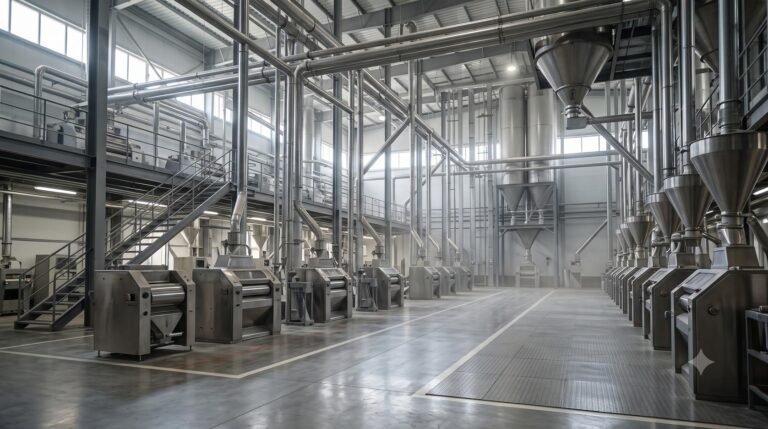
Plant layout is where the manufacturing process meets the building. An effective layout moves raw material through production, quality control, storage, and dispatch with minimal handling and congestion, while accounting for machinery footprints, maintenance access, employee movement, emergency egress, and future capacity. Layout errors create bottlenecks that persist for the life of the facility — which is why layout should be developed around the process, not by fitting machinery into a building already designed. Three-dimensional modelling helps identify spatial conflicts before implementation.
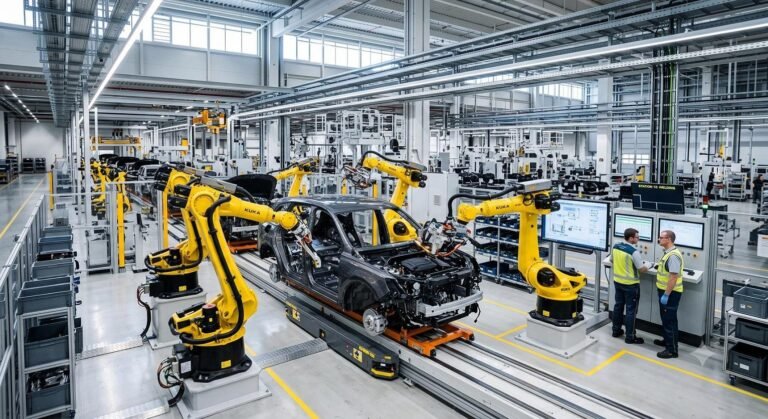
Machinery typically represents a substantial share of project investment, and selection extends well beyond purchase price to capacity, product specification, automation, reliability, energy consumption, maintenance, spares, technical support, delivery schedules, and integration. Line balancing matters as much as individual equipment: a single high-capacity machine adds no output if upstream or downstream operations cannot match its rate.
CAPEX planning covers land, site development, buildings, civil works, machinery, utilities, electrical infrastructure, warehousing, material handling, environmental systems, engineering, installation and commissioning. OPEX covers raw materials, manpower, power, water, fuel, maintenance, consumables, logistics and waste management. Evaluated together, they reveal where lower initial investment creates higher long-term operating cost — and where additional upfront spend on automation or energy efficiency pays back.
Regulatory Planning Belongs in the Design Phase
A new plant can require factory approvals, pollution-control consents, environmental clearances, fire safety approvals, building permissions, labour registrations, industrial licences, and sector-specific registrations depending on industry, product, location, workforce, and process.
These requirements shape design directly. Environmental controls influence utilities and process infrastructure; fire-safety requirements affect access, storage, building configuration and emergency systems. Regulated sectors — pharmaceuticals, medical devices, food, chemicals — carry additional facility, quality, documentation and testing obligations.
Developing a regulatory approval roadmap during the planning stage can help businesses coordinate statutory requirements with engineering, construction, and project schedules. Approval roadmaps built on the earlier framework need revisiting.
Execution and Commissioning
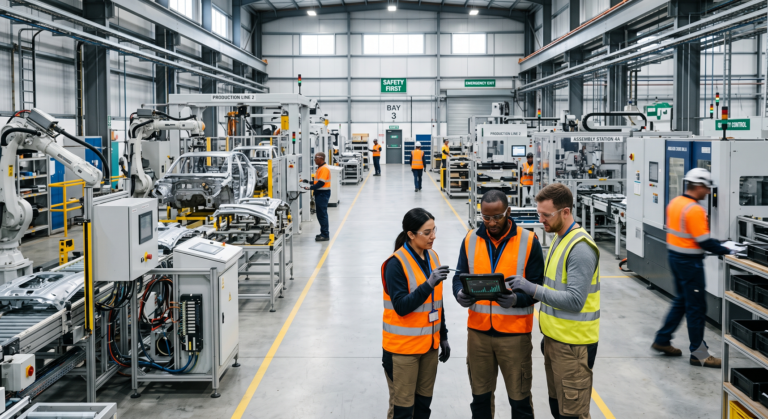
Greenfield projects run multiple interdependent workstreams — engineering, approvals, civil construction, machinery procurement, utility development, vendor coordination, recruitment, installation, testing and commissioning — all against a target production date. Long-lead equipment deserves particular attention, since procurement slippage propagates through the entire schedule.
Completing construction does not make a plant operational. Machinery, utilities, electrical systems, controls and material-handling systems must be installed, inspected, tested and commissioned, with equipment trials preceding integrated production runs. This stage surfaces issues in equipment interfaces, utilities, production flow, quality, cycle times and operating procedures, and a structured commissioning process is what converts a completed building into stable manufacturing operations.
IMARC Engineering’s Greenfield Support
IMARC Engineering supports manufacturers, investors, project developers and international businesses planning greenfield manufacturing projects in India. Its capabilities span feasibility studies, location analysis and site selection, technical due diligence, plant layout and process flow, machinery identification, supplier evaluation, CAPEX and OPEX planning, regulatory approvals, project scheduling, engineering coordination, installation and commissioning, and site supervision.
“ Some of the most expensive mistakes in a greenfield project can originate during the early planning stage, well before construction begins,” said Akshay Agrawal, IMARC Engineering. “By the time a layout constraint or missed approval surfaces on site, correcting it can become significantly more expensive.”
By bringing engineering, regulatory, sourcing and project-management considerations into one framework, the firm helps businesses identify requirements before they become execution-stage changes.
Discuss your project requirements: https://www.imarcengineering.com/contact-us
About IMARC Engineering
IMARC Engineering provides engineering, project advisory, manufacturing plant setup, regulatory, sourcing, and industrial consulting services for businesses establishing and expanding manufacturing operations in India. Its capabilities span feasibility studies, site selection, plant layout and process flow, machinery and supplier identification, CAPEX and OPEX planning, regulatory approvals, project scheduling, installation and commissioning, site supervision, and greenfield and brownfield project management.
The firm works with manufacturers, investors, project developers, EPC and EPCM organisations, domestic businesses, and international companies developing industrial projects in India.
Media Contact
IMARC Engineering
Email: media@imarcengineering.com
Website: https://www.imarcengineering.com/
India: C-130, Sector 2, Noida, Uttar Pradesh 201301 | +91-120-433-0800