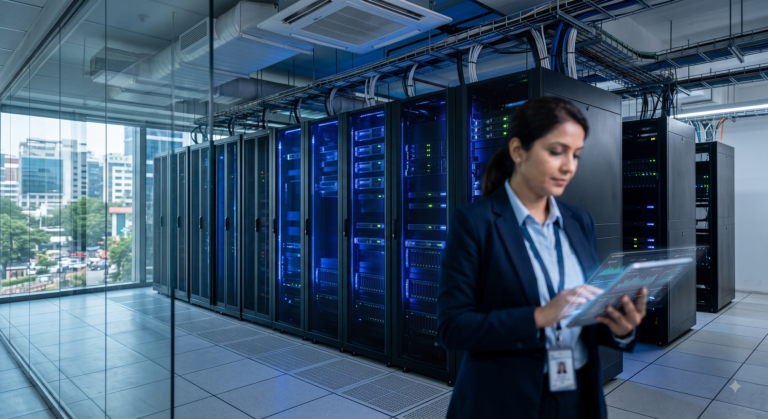

NEW YORK, USA — July 6, 2026 (ACI Newswire) — Global enterprise investment in edge computing infrastructure is expanding as organizations prioritize low-latency data processing and reduced bandwidth consumption. As industries deploy more connected devices, the physical distance between data generation and centralized cloud servers continues to create operational bottlenecks. This logistical reality is prompting a structural shift toward decentralized processing models, where data is analyzed near its point of origin.
Edge computing enables organizations to bypass the latency inherent in sending raw data to distant hyperscale data centers. By processing information locally—on factory floors, in retail locations, or at cellular base stations—companies can support applications that require immediate computing responses. Industry analysts observe that this decentralization is no longer a localized experiment but a core component of enterprise IT strategy.
The Shift Toward Localized Data Processing
The sheer volume of data generated by enterprise operations is straining traditional cloud architectures. Industrial Internet of Things (IoT) networks, autonomous vehicles, and automated supply chains produce terabytes of data daily. Routing all of this information back to a central server creates significant network congestion and introduces delays.
To mitigate these challenges, technology architects are deploying ruggedized servers, micro-data centers, and local gateways directly at the network periphery. This hardware filters and analyzes data immediately upon generation. Only relevant insights or long-term storage data are transmitted to the central cloud, preserving network bandwidth and maintaining local system responsiveness.
Industrial Automation and Manufacturing Demands
The manufacturing sector is emerging as a primary driver of edge infrastructure deployments. Modern assembly lines rely heavily on computer vision systems and robotics to identify defects, manage inventory, and prevent equipment failures. These applications require millisecond response times to function safely and effectively.
If a robotic arm detects an obstruction on an assembly line, the system cannot wait for a round-trip data transmission to a remote data center before initiating an emergency shutdown. Edge computing brings decision-making capabilities to the factory floor, ensuring that critical automation systems operate with near-zero latency. Plant managers are increasingly standardizing these localized compute environments to improve overall equipment effectiveness and worker safety.
Telecom Networks and 5G Integration
The expansion of 5G cellular infrastructure is closely tied to edge computing adoption. Telecommunications providers are deploying multi-access edge computing (MEC) nodes directly at cell towers and network aggregation points. This architecture allows mobile network operators to offer enterprise clients dedicated compute resources physically closer to mobile devices and remote facilities.
By combining the high bandwidth of 5G with the localized processing of MEC, telecommunications companies are supporting a new tier of mobile applications. Fleet management systems, remote maintenance drones, and field service augmented reality tools rely on this combined infrastructure to maintain continuous, high-speed data streams without overwhelming central cellular backbones.
Data Governance and Regulatory Compliance
Beyond speed and efficiency, edge computing addresses complex regulatory and data sovereignty requirements. Governments and regulatory bodies are enforcing stricter rules regarding where digital information is stored and how it is processed. This is particularly relevant in the healthcare and financial sectors, where cross-border data transfers often violate privacy mandates.
Edge architecture allows hospitals and regional banks to process sensitive information entirely within their own local firewalls. Patient diagnostics, biometric data, and localized financial transactions can be analyzed without ever transmitting personally identifiable information across public network routes. This localized approach simplifies compliance audits and reduces the legal risks associated with large-scale data aggregation.
Managing Cloud Egress Fees and Bandwidth Costs
Financial considerations are accelerating the transition away from cloud-only models. Major cloud service providers charge significant egress fees for moving data out of their data centers, and telecommunications carriers bill for the bandwidth required to transmit it. Continuously streaming uncompressed video feeds or raw telemetry data to a centralized cloud quickly becomes cost-prohibitive.
Implementing compute capabilities at the edge allows enterprises to perform data triage. An edge-enabled security camera, for example, can discard hours of static footage and only upload video clips containing movement or specific identified objects. This architectural strategy significantly lowers monthly cloud transmission costs and reduces the total cost of ownership for distributed IT networks.
Evolution of Hybrid IT Architectures
The rise of edge computing does not signal the decline of centralized cloud infrastructure. Instead, industry analysts note the maturation of a hybrid computing ecosystem. The edge handles immediate, tactical operations, while the central cloud manages historical data analysis, deep machine learning model training, and company-wide aggregate reporting.
Major technology vendors are responding by integrating their enterprise software across both environments. Cloud hyperscalers are releasing edge-specific software stacks that allow developers to build an application once and deploy it either in a central data center or on a remote edge gateway. This unified management approach reduces friction for IT operations teams tasked with securing thousands of distributed devices.
Market Outlook
As real-time processing requirements expand, enterprise adoption of edge computing infrastructure is expected to scale proportionally. Hardware manufacturers are actively developing specialized, low-power processors designed specifically for harsh edge environments, while software providers are refining containerized application deployment for distributed networks.
The successful implementation of these technologies requires careful planning around network security, device management, and power consumption at remote sites. Organizations that effectively balance central cloud resources with edge processing capabilities are establishing more resilient, cost-effective, and responsive operational frameworks.
About ACI Newswire
ACI Newswire is a premier global syndication network delivering objective, high-impact business journalism, financial announcements, and industry analysis. Committed to editorial integrity and factual reporting, ACI Newswire connects enterprises with investors, analysts, and major media outlets worldwide. We provide institutional-grade news distribution across the technology, finance, and industrial sectors.
Suggested Media Contact:
ACI Newswire
contact@acinewswire.com