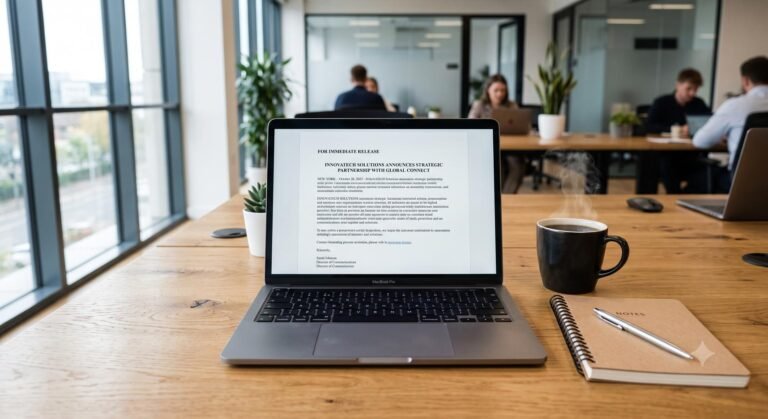

Journalists and news editors receive hundreds of pitches every single day. Most of those emails are deleted within seconds. If you want your company’s news to be read, understood, and ultimately published, you need to deliver the information exactly how reporters expect to receive it.
The standard press release format exists for a simple reason: efficiency. It strips away the marketing fluff and presents the facts in a predictable, easily scannable structure. When a reporter opens your press release, they should know immediately who you are, what happened, why it matters, and who to contact for more information.
This guide explains the exact anatomy of a professional press release. You will learn the specific components required, how to arrange them, and how to avoid the formatting errors that immediately mark an announcement as amateur.
What is a Press Release?
A press release is an official, standardized written communication sent to the news media to announce something newsworthy. Its primary purpose is to secure media coverage by providing reporters with the basic facts they need to write a news story.
Why the Format Matters
Media professionals are perpetually on a deadline. They do not have time to hunt for a media contact hidden at the bottom of a page, or decode a clever but vague headline.
Using the industry-standard layout signals that you understand how a newsroom operates. It removes friction. A properly formatted release acts as a plug-and-play resource for a busy writer. They can easily lift your quotes, copy your statistics, and paste your background information directly into their draft.
The Key Components of a Press Release
A professional press release follows a strict structure, moving from the most critical information at the top to background details at the bottom. This is known in journalism as the “inverted pyramid.”
Here are the essential elements, listed in the exact order they should appear on the page.
1. Release Timing Status
At the very top of the document, usually aligned to the left and in all capital letters, you must indicate when the information can be published.
-
FOR IMMEDIATE RELEASE: The media can publish the news right now. This is the most common status.
-
EMBARGOED UNTIL [Date and Time]: You are sharing the news early, but the media cannot publish it until the specified time. Use this sparingly and only with trusted contacts.
2. Headline
The headline is the most important part of your press release. It determines whether the email gets opened.
Keep it factual, active, and free of hype. It should read like a news headline, not a sales pitch. Aim for under 100 characters. Center the headline and use bold text.
3. Dateline
The dateline begins the first paragraph of your press release. It tells the reporter where the news is originating and when it happened.
Format it with the city in all capital letters, followed by the state abbreviation, and the date.
Example: CHICAGO, Ill., October 12, 2026 —
4. The Lead Paragraph
The first paragraph must answer the fundamental questions of journalism: Who, what, when, where, and why.
If a reporter only reads this single paragraph, they should understand the entire story. Keep this section to three or four sentences maximum.
5. Body Paragraphs
The subsequent paragraphs provide context. Here, you can include supporting statistics, background information on why the announcement matters, and details about the product, event, or hire.
Keep paragraphs short. Two to three sentences per paragraph is ideal for readability.
6. Quotes
Always include at least one quote from a key stakeholder, such as a CEO, founder, or project lead.
Quotes should not repeat facts already stated in the body. Instead, they should offer perspective, emotion, or opinion. Provide the human element that a reporter cannot get from a stat sheet.
7. Boilerplate
A boilerplate is a short, standardized “About” section found at the bottom of every press release a company issues. It provides a brief overview of what the company does, its founding year, its mission, and a link to the corporate website.
Think of the boilerplate as your company’s permanent elevator pitch.
8. Media Contact Information
Place your contact details at the bottom of the release. If a reporter wants to write a story, they need a fast way to ask follow-up questions or schedule an interview.
Include:
-
Name of the primary media contact
-
Professional title
-
Email address
-
Phone number
9. The End Mark
To signal to the reporter that the press release is finished and there are no additional pages, center three pound signs at the bottom of the document.
Example: ###
Press Release Format Anatomy
This table provides a quick visual reference for how a press release should look on a standard letter-sized document.
| Element | Placement & Formatting | Purpose |
| Release Status | Top left corner, ALL CAPS. | Tells media when they can publish. |
| Headline | Centered, Bold, Title Case. | Summarizes the core news clearly. |
| Dateline | Start of the first paragraph. Bold. | Establishes the origin city and date. |
| Lead Paragraph | First paragraph. Standard text. | Delivers the 5 Ws (Who, What, When, Where, Why). |
| Body / Quotes | Standard paragraphs. | Provides context, details, and executive insight. |
| Boilerplate | Bottom section, under an “About [Company]” header. | Explains who the company is. |
| Media Contact | Bottom left or centered, below boilerplate. | Gives reporters a direct line for interviews. |
| End Mark | Centered at the very bottom (###). | Indicates the end of the text. |
Press Release Examples
Seeing the format in action is the best way to understand it. Below are two examples of common corporate announcements, structured according to industry standards.
Example 1: Product Launch Announcement
FOR IMMEDIATE RELEASE
ApexTech Unveils DataShield Pro to Prevent Small Business Cyberattacks
AUSTIN, Texas, August 14, 2026 — ApexTech, a regional provider of commercial cybersecurity software, today announced the launch of DataShield Pro, a new automated threat-detection platform built specifically for businesses with fewer than 50 employees. The software will be available nationwide starting September 1.
Historically, enterprise-grade threat detection has been priced out of reach for independent businesses. DataShield Pro resolves this by utilizing a scaled-down, cloud-based monitoring system that secures localized servers without requiring an in-house IT team.
“Small businesses are the targets of 43% of all cyberattacks, yet they have the fewest resources to defend themselves,” said Sarah Jenkins, CEO of ApexTech. “We built DataShield Pro to provide Main Street businesses with the same defensive architecture used by Fortune 500 companies, at a price point that makes sense for their margins.”
The platform features automated daily backups, real-time phishing alerts, and a one-click lockdown protocol. Early beta testing across 200 Texas retailers showed a 94% reduction in successful malware intrusions over six months.
DataShield Pro is priced at $199 per month, with no annual contract requirement.
About ApexTech
Founded in 2021, ApexTech develops accessible cybersecurity solutions for the small business sector. Headquartered in Austin, Texas, the company currently secures over 4,000 independent businesses across the American Southwest. For more information, visit www.apextech-fictional.com.
Media Contact:
David Chen
Director of Communications, ApexTech
d.chen@apextech-fictional.com
(555) 019-8372
###
Example 2: Executive Hire Announcement
FOR IMMEDIATE RELEASE
GreenLeaf Energy Appoints Marcus Thorne as Chief Sustainability Officer
PORTLAND, Ore., November 3, 2026 — GreenLeaf Energy, a national supplier of commercial solar infrastructure, today announced the appointment of Marcus Thorne as Chief Sustainability Officer (CSO). Thorne will oversee the company’s internal transition to a zero-waste manufacturing process and lead the development of community solar initiatives.
Thorne brings over 15 years of environmental policy and corporate governance experience to GreenLeaf. He previously served as the Director of Renewable Initiatives at the Pacific Energy Board, where he managed a $40 million grant program for urban solar adoption.
“Marcus has a proven record of turning complex environmental goals into measurable operational realities,” said Elena Rostova, President of GreenLeaf Energy. “As we scale our manufacturing across the Pacific Northwest, his expertise will ensure our internal practices are as clean as the energy grids we build.”
In his new role, Thorne will report directly to the President. His first initiative will be auditing the supply chain of GreenLeaf’s primary manufacturing facility in Bend, Oregon.
“GreenLeaf is uniquely positioned to change how commercial real estate interacts with the grid,” Thorne said. “I am eager to join a team that values long-term ecological impact just as highly as quarterly growth.”
Thorne holds a Master of Environmental Management from Yale University and currently serves on the advisory board of the Oregon Clean Energy Alliance.
About GreenLeaf Energy
GreenLeaf Energy is a commercial solar provider specializing in large-scale rooftop installations for retail centers, warehouses, and corporate campuses. Since 2015, GreenLeaf has installed over 200 megawatts of solar capacity across the United States. Learn more at www.greenleafenergy-fictional.com.
Media Contact:
Samantha Vance
PR Manager
svance@greenleafenergy-fictional.com
(555) 012-9934
###
Common Formatting Mistakes to Avoid
Even a highly newsworthy announcement will be ignored if it is presented poorly. Avoid these frequent errors.
| Mistake | Why it Fails | How to Fix It |
| Burying the Lead | Reporters won’t read past the first paragraph to figure out what the news is. | Put the most vital information in the very first sentence. |
| Using Jargon | Buzzwords confuse readers and make the release sound like a sales pitch. | Write in plain English. Assume the reader is smart but outside your specific industry. |
| Excessive Length | A multi-page document is overwhelming and suggests a lack of focus. | Keep the total word count between 300 and 500 words. Stick to one page if possible. |
| Missing Contact Info | If a journalist wants to interview you but can’t find a phone number, they will move on. | Always include a clear media contact at the bottom. |
| Writing in First Person | Press releases are objective news documents, not personal letters. | Always write in the third person (“The company announced,” not “We are announcing”). |
Best Practices for Writing and Formatting
To ensure your press release looks professional and reads well, follow these standard guidelines:
-
Use a standard font: Stick to simple, legible fonts like Arial, Times New Roman, or Calibri. Use a 10- or 12-point font size.
-
Paste text into the email body: Never send a press release exclusively as an attachment. Many journalists delete emails with attachments due to security protocols. Paste the text directly into the body of your email.
-
Keep formatting simple: Avoid colorful text, multiple font styles, or excessive bolding. Let the facts carry the weight.
-
Use bullet points sparingly: You can use bullets to break down complex features or statistics, but the main narrative should be in paragraph form.
-
Include multimedia links: Instead of attaching large image files, include a link to a Dropbox or Google Drive folder containing high-resolution logos, headshots, or product photos.
Benefits and Limitations of Press Releases
A press release is a tool, and like any tool, it has specific uses and limitations.
Benefits
-
Establishes an official record: It acts as the definitive source of truth regarding your company’s news, dates, and spelling of executive names.
-
Controls the narrative: You get to frame the story and provide the exact quotes you want the public to see.
-
Scalability: You can write one document and send it to dozens of relevant journalists, ensuring they all receive the same accurate information simultaneously.
Limitations
-
No guarantee of coverage: Writing a press release does not mean a newspaper will print it. If the news is not compelling to their specific audience, they will ignore it.
-
Can feel sterile: The strict format leaves little room for creative storytelling or humor.
-
Not a substitute for relationships: Sending a press release to a generic newsroom email is rarely as effective as pitching an exclusive story to a reporter you already know.
Key Takeaways
-
A press release is an objective news document, not a marketing flyer.
-
Always structure the document using the inverted pyramid, placing the most important facts at the very top.
-
Include standard elements: FOR IMMEDIATE RELEASE, Dateline, Boilerplate, and Media Contact.
-
Keep the release short, ideally under 500 words, and write in the third person.
-
Paste the text directly into your pitch email rather than forcing journalists to open an attachment.
Frequently Asked Questions
How long should a press release be?
A standard press release should be between 300 and 500 words, which is roughly one printed page. If it exceeds two pages, it is too long and needs editing.
Should I attach a press release as a PDF or put it in the email body?
Always paste the text directly into the body of your email. Many newsrooms have strict IT policies that block emails with PDF or Word attachments to prevent malware.
What does ### mean in a press release?
The three pound signs (###) centered at the bottom of the page signify the end of the document. This is an old wire service tradition that tells the editor there are no missing pages.
What is a boilerplate?
A boilerplate is the “About the Company” paragraph at the bottom of the press release. It remains identical across all your company’s announcements and provides basic background information, such as your founding date, location, and primary business function.
When is the best time to send a press release?
Historically, Tuesday or Wednesday mornings (between 8:00 AM and 10:00 AM local time) are considered the most effective times to send news. Avoid Friday afternoons, as newsrooms are winding down and your announcement will likely be buried by Monday morning.
Do press releases still help with SEO?
They help indirectly. While syndicating a press release on a wire service used to provide direct SEO value through link building, search engines now typically discount those links. However, if a reporter reads your release and writes an original article on a high-authority news site that links back to you, that earns significant SEO value.
Can I use bullet points in a press release?
Yes. Bullet points are highly effective for breaking down technical product features, survey statistics, or event schedules. However, your lead paragraph and quotes should always be written as standard sentences.
What is the difference between a press release and a pitch?
A press release is a formal, detailed document that contains all the facts of the announcement. A pitch is the short, persuasive email you write to a specific journalist to convince them to read the attached press release.
Do I need to use a PR distribution service (a wire service)?
Not necessarily. Wire services (like PR Newswire or Business Wire) are expensive and primarily useful for publicly traded companies fulfilling disclosure requirements, or for reaching a broad national audience. For most small to mid-sized businesses, emailing a targeted list of industry reporters is much more cost-effective.
How many quotes should a press release have?
Stick to one or two quotes maximum. Usually, one quote from a top executive and one quote from a relevant partner or customer is sufficient. Having too many quotes clutters the document and dilutes the impact.
Conclusion
Mastering the press release format is a fundamental skill for anyone handling corporate communications or public relations. While the media industry changes rapidly, the demand for clear, accurate, and easily accessible facts remains constant.
By adhering to this established structure, you show reporters that you respect their time and understand their profession. Focus on writing clean, objective copy that clearly explains why your announcement matters to the public. Once you have a truly newsworthy story, wrapping it in the correct format gives it the best possible chance of being published.